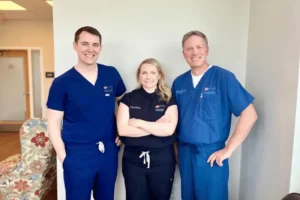
 Dr. Travis McCoy, MD
Reproductive Endocrinologist
Advanced Gynecologic Surgery
What Is PCOS?
PCOS or polycystic ovary syndrome is the most common female disorder, and it affects 15-27% of women. It is classified as a disorder as not regularly ovulating and overproducing the male hormones. The primary issue is the brain signal from the pituitary to the ovaries creates inconsistent ovulation. This includes when women don’t ovulate regularly but can have periods, intermittent or irregular periods, they can skip a period, or will not have them altogether. These are all similar in that they are not ovulating regularly. When women don’t ovulate regularly and overproduce male hormones which leads to more irregular ovulation, so it’s a disorder of multiple vicious cycles that feed each other over time.
Is it hereditary?
It does have a strong family tendency but it is not directly inherited. It’s initiated at puberty and usually has been there but it’s hard to recognize at a very young age because it’s normal for cycles to be irregular in young women who have not been of age for a long period. Typically it begins to show up in the mid to late teenage year with symptoms of irregular cycles, excess male hormones, acne, male pattern hair growth, and darker hair in the area of the face, chest, and abdomen.
What is the treatment?
It is a lifelong disorder in which the patients usually always ovulate inconsistently. Treatment is dependent upon whether she is trying to conceive or not. If not we use a hormonal suppression pill that helps regulate hormones and cycles. Also, many women with PCOS can be prediabetic and are treated with medication such as metformin or similar meds. In women who have excess hormones that extenuate male pattern hair growth, other medicines are used to block those hormones.
What is the cause?
It’s not exactly known ad there are various theories as to why the pituitary glands, ovaries, and adrenal glands are involved in this. If a patient is untreated it is estimated 30% will be near-diabetes by age 30, though the risk for developing it is highly correlated with excessive weight and a family history of type-2 diabetes.
 Male hormones encourage weight gain and the hormones encourage pre-diabetes which also encourages weight gain. The pre-diabetes and weight feed each other to keep progressing over and over in this vicious cycle.
Many patients with PCOS are the lean type of normal body weight and they do not have nearly the risk for pre-diabetes. Their primary issues are irregular cycles and male hormone production.
What about PCOS with fertility patients?
30% of fertility patients have PCOS. If the patient wants to get pregnant the first steps we take are to make sure we are not dealing with any other hormonal issues that can mimic PCOS. We want to get the patient to a healthy place because there is the risk in pregnancy of becoming pre-diabetic and if the patient is already pre-diabetic we want to eliminate the further risk of having her get full-blown type-2 diabetes. So by trying to treat this before they get pregnant significantly improves pregnancy outcomes and helps lower that risk.
How do you treat PCOS fertility patients?
 The mainstay is using medicines to induce ovulation. Basically to get the brain to send the right signals to start ovulation. Then we monitor using ultrasounds and time when she is fertile. Some women with PCOS can be extremely fertile and it’s purely an ovulation issue so it’s fairly easy for them to get pregnant. Other women for reasons not well understood can be very difficult to get pregnant despite ovulating over and over, the underlying factor. When we get them to ovulate it does cause all those hormones to flourish and it will continue during treatment but the increased and more regular ovulation is what helps increase her chances to get pregnant. Many times they haven’t had the chance to get pregnant on their own.
How do obesity and BMI come into play with PCOS?
 The patients who are obese, usually have at least some pre-diabetes so in these patients if they are able to work, exercise, and lose weight it makes ovulation easier which increases their chances. But exercise, working out, diet, and weight control also significantly helps improve the health of the baby once pregnant. Our first recommendation is always diet and exercise. And it’s challenging because so many times their hormones have been fighting them their whole life, but studies show if the patient can just lose 10% of their body weight, it will lead to increased ovulation and a greater chance for pregnancy.
Usually, these women have always battled weight and the PCOS does make it so much more difficult to lose weight because of hormonal issues. Even when you work to control the weight is always a battle and unfortunately a lifelong battle, but the main goal outside it try and control hormones, keep weight down, and try to be a healthy overweight to reduce the long-term risk of heart disease. Patients with PCOS have a greater chance of developing diabetes and heart disease. Prediabetes
What about PCOS care after pregnancy?
If a woman does get pregnant and has a baby, the best thing is to stay on a birth control pill anytime she is not actively trying to get pregnant. She needs to control the hormones for general health and future fertility concerns. The hormones of pregnancy suppress a lot of those male hormones so going directly into a pill after delivery helps maintain that improved state.
PREG has 3 IVF Centers (Greenville, Columbia & Lowcountry) with offices in Asheville & Spartanburg.
866.725.7734